In this area
The Madrid issue
Chueca, Madrid: the barrio that stays up, dresses well and welcomes everyone
A compact grid between Gran Vía and the Salesas, Chueca folds vermut counters, Michelin kitchens, drag cabaret and Pride history into a few walkable blocks.
By Carmen OteroOne plaza and corrala at a time
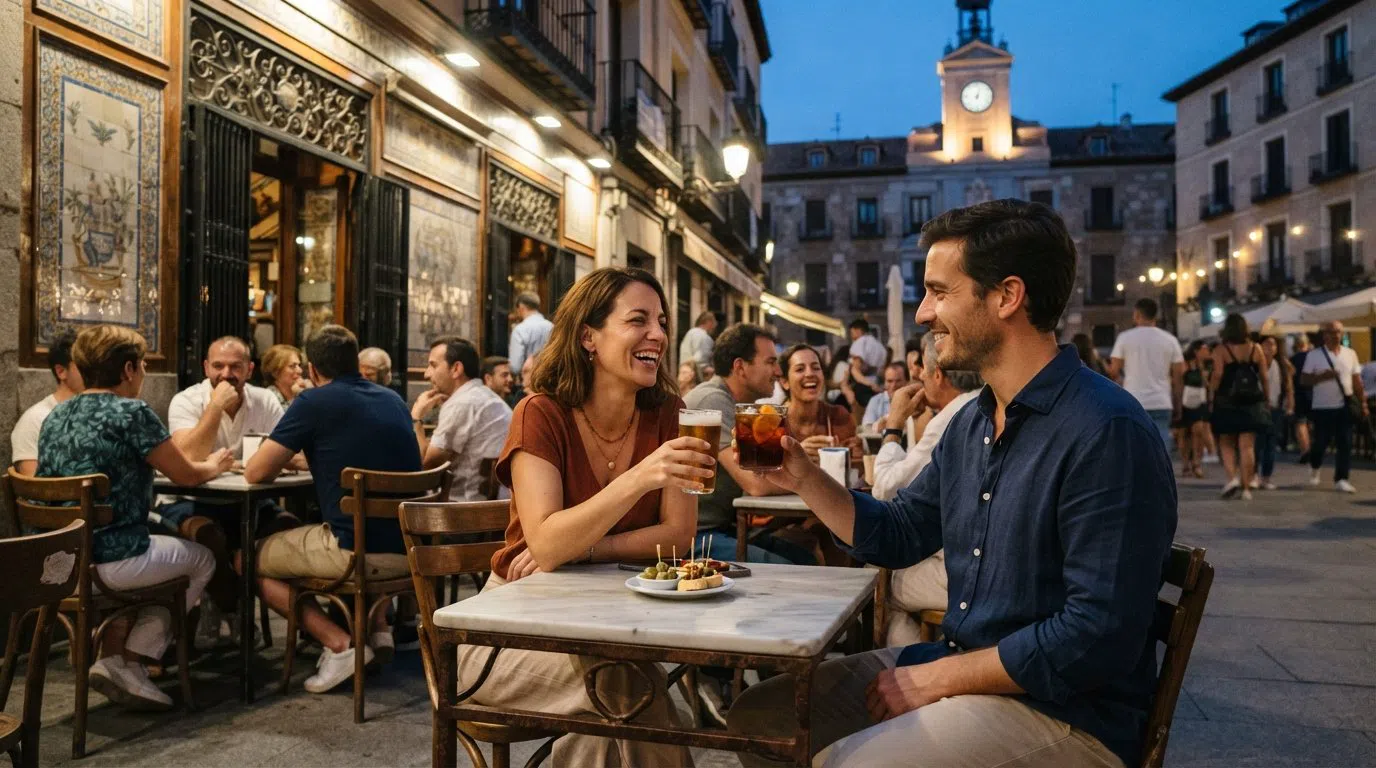
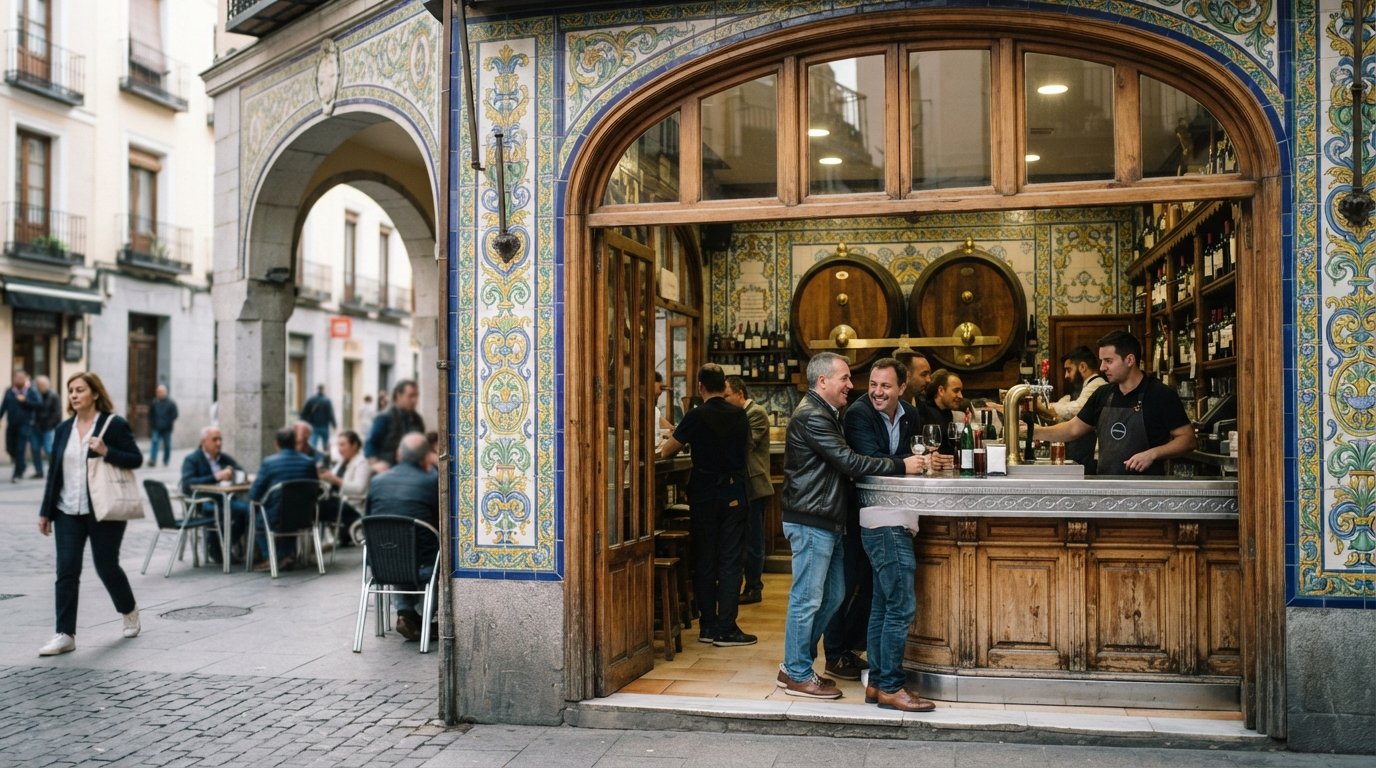
Chueca begins with a glass of vermut standing on a tiled counter. At Taberna Ángel Sierra, on Plaza de Chueca, the tap has been pouring since 1917, and the room still looks like a place where time has been measured in lunch hours rather than trends: carved wood, oak vats, a bar that invites you to linger upright. Step outside and the barrio is all around you at once — a compact grid, barely six blocks wide, with a rhythm that changes by the hour. By mid-morning there are locals on the plaza with coffee; by night the same streets are threaded with terrace tables, drag posters and the kind of conversation that keeps drifting until dawn.
What Chueca is known for
Chueca is Madrid's LGBTQ+ neighbourhood, full stop, and it does not perform that identity as a slogan so much as live it as ordinary civic weather. The centre of gravity is Plaza de Chueca, with Calle Pelayo and Calle Libertad running out from it like nerves, and Plaza de Pedro Zerolo giving the barrio its ceremonial heart. Zerolo's name matters here; this is not a decorative rainbow district but a place with a memory, one that has made room for celebration, politics and commerce without separating them too neatly.
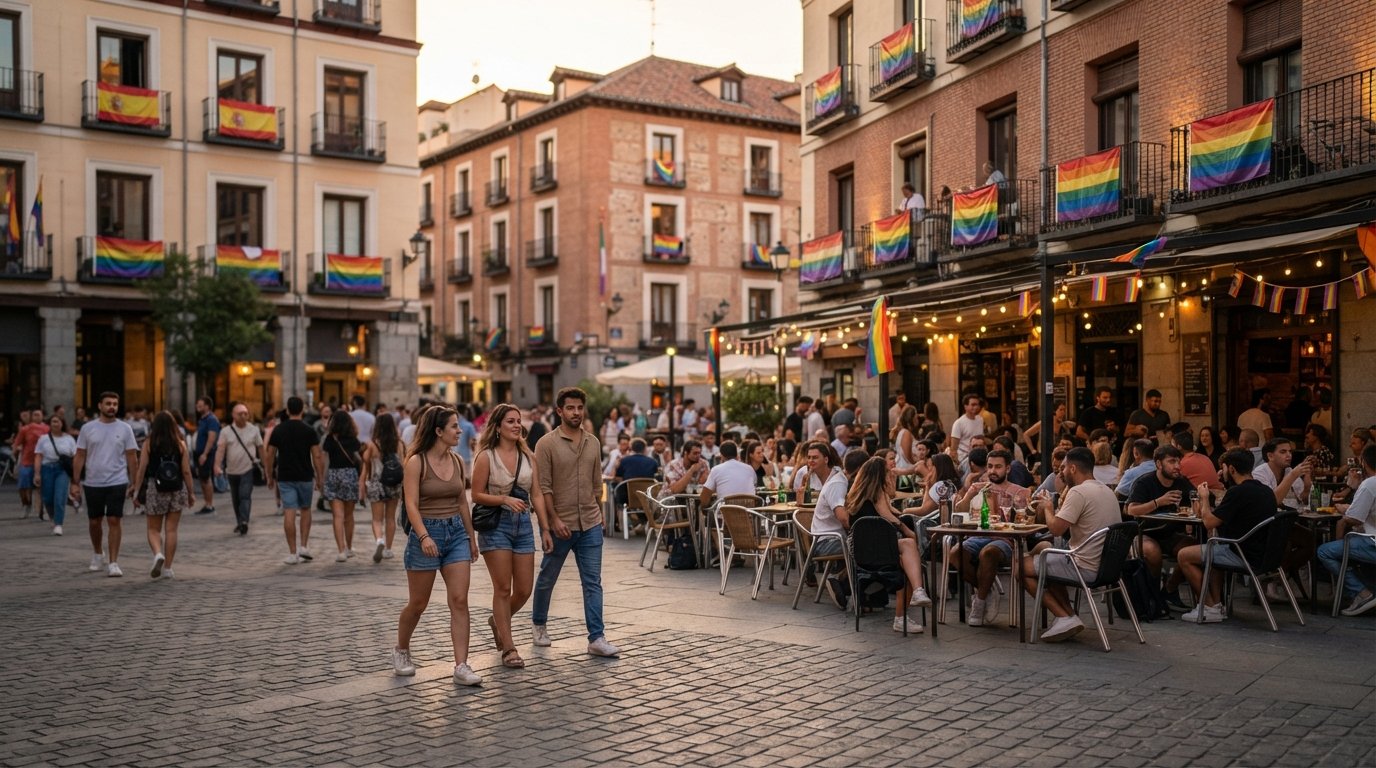
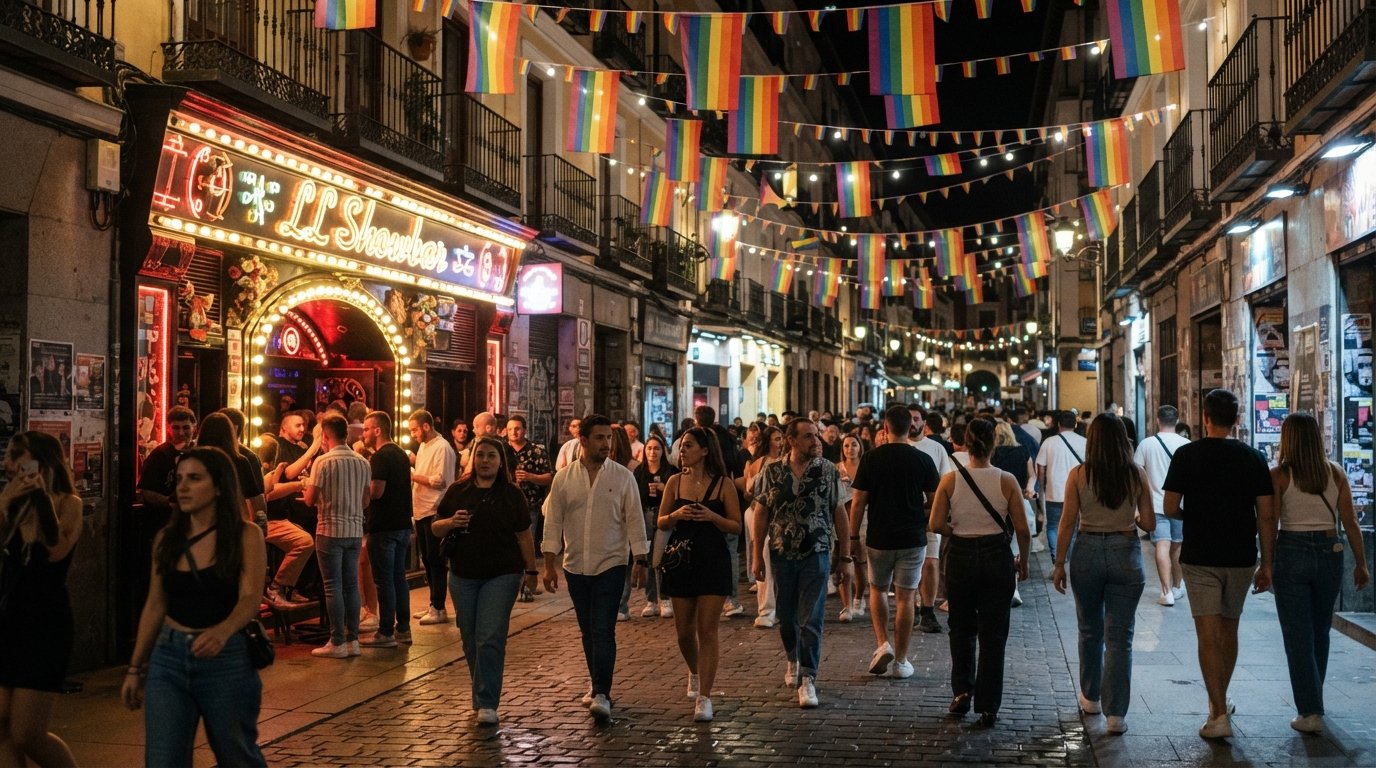
In late June and early July, that memory becomes visible in the streets. MADO (Madrid Orgullo) takes over Chueca and the surrounding centre, turning squares into free open-air stages and sending a parade from Atocha to Colón. In 2026 it runs roughly from 25 June to 5 July. You feel the scale of it not only in the crowds, but in the way the neighbourhood prepares for them: flags already hanging year-round, bars already used to the noise, doorways already open to whoever walks in. Chueca is proud of its welcome, and more importantly, it has had time to make that welcome habitual.
The daytime version of the barrio is quieter than its reputation suggests. It is a grid of narrow one-way streets that feels more boutique than boozy, with independent perfumeries, sneaker shops and a covered market giving it a polished, design-literate air. The evening version arrives without warning. Light drops, terraces fill, and the music starts leaking from a dozen bars at once. The neighbourhood's social range is part of the charm: couples, groups of friends, international visitors, regulars who know exactly which corner they want. Even the dive bars here dress the part.
Plan your Madrid trip
Live prices from our booking partners.
Guests & rooms
Free cancellation on many rooms. We may earn a commission when you book.
Where to eat & drink
If you want to understand Chueca properly, eat and drink your way through it in layers. Start at the oldest edge of the story, then work forward.
Taberna Ángel Sierra is the obvious beginning: vermut on tap, since 1917, in a room that still feels like a proper taberna rather than a theme. It is the sort of place where the first drink of the day can become the preface to lunch without anyone needing to announce the shift. A minute away on Calle Libertad, Celso y Manolo brings a different kind of continuity. This reborn Asturian tasca keeps the old comforts — tortilla paisana, fabada — but sets them against a multicolour marble bar and a long natural-wine list. It is one of those places that manages to be both nostalgic and current without sounding strained.
La Carmencita, also on Calle Libertad, goes deeper into the neighbourhood's memory. It claims to be Madrid's second-oldest taberna, open since 1854, and once counted Lorca among its visitors. That history sits lightly on the room; what matters is that it still functions as a place to eat and drink now, not as a museum of itself. Chueca has a gift for preserving continuity without freezing it.
For a quieter lunch, Bosco de Lobos hides in the courtyard garden of the College of Architects on Calle Hortaleza 63. It is one of those places that feels almost secret the first time you find it, with antipasti, pasta and pizza served among the plants or in a library-style dining room. The garden setting changes the pace of the meal. You arrive from the street and the city seems to step back a little.
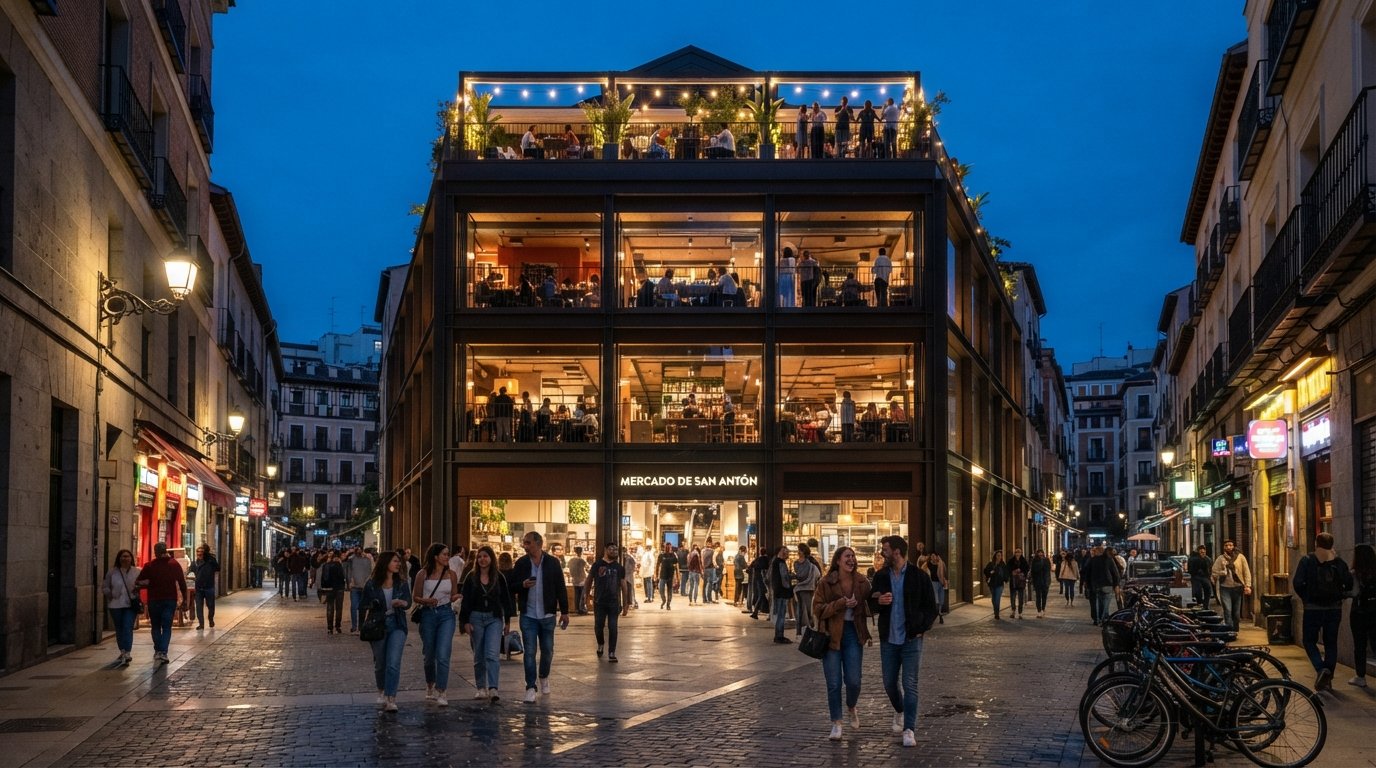
The barrio's culinary anchor, though, is Mercado de San Antón on Calle Augusto Figueroa. Reborn in 2012, the three-floor market helped write the playbook for Madrid's gourmet-market boom, and it still feels central to the way Chueca eats. The ground floor is a working market of produce, cheese and jamón; upstairs, the stalls and terraces turn browsing into lunch. At the top sits 11 Nudos Terraza Nordés, where the rooftop looks out over the neighbourhood and the kitchen leans Atlantic: charcoal-cooked fish and meats, Iberian-ham croquetas, Nordés-gin cocktails. It is a good place to watch the barrio from above and remember that its polish is not an accident.
At the top end of the scale, Chueca can be serious indeed. DSTAgE, on Calle Regueros 8, is Diego Guerrero's raw-concrete loft and a two-Michelin-star address for playful tasting menus. The room is spare, almost industrial, which throws the food into sharper relief. A little further north, Toki offers the opposite: an intimate six-seat omakase counter on the barrio's edge, with one Michelin star and the concentration that such a small room demands. Between them, Chueca covers a lot of ground — from a stand-up vermut to a tasting menu that asks for your full attention.
Going out
Chueca goes out late, and it does so with standards. The classic-cocktail side of the neighbourhood is represented by Del Diego on Calle de la Reina 12, opened in 1992 by Fernando del Diego, a protégé of Perico Chicote. Under its soaring ceiling, it remains a temple of the well-made drink; order a Manhattan or the house Del Diego and watch the bar do the work properly. Around the corner, Angelita on Calle de la Reina 4 takes a different route to seriousness: more than 2,000 wines upstairs, a creative cocktail lounge below, and a place on The World's 50 Best Bars list. It is the sort of bar that can absorb both a serious wine conversation and a late drink after dinner.
Then there is the nightlife that made the barrio famous. Most of it gathers along Calle Pelayo, and the mood changes with the hour. LL Showbar, at Pelayo 11, is the landmark drag-and-cabaret room, pulling in a couple of hundred people for near-nightly shows from around 10pm. Black & White, on Calle Libertad 34, has been going since the 1980s and is often cited as Madrid's oldest continuously running gay bar. Together they explain why Chueca remains a reference point far beyond Madrid: not because it is loud, though it is, but because the noise has a history and a social purpose.
The rhythm here is unmistakably Spanish. Dinner around 10pm is normal. The first drink often comes after midnight. Dance floors do not really fill until 2am or 3am. On a Saturday, the streets can still be busy at dawn. That is not a warning so much as a fact of life. Chueca is generous with its nights, but it expects you to keep pace.
Things to do / what to see
Chueca is less a neighbourhood to tick off than one to absorb, but there is one cultural anchor worth building a morning around: the Museo del Romanticismo on Calle San Mateo 13. The building itself is a 1776 palace, furnished as a bourgeois 19th-century home, with paintings by Goya and Bécquer in the period rooms. It is the kind of museum that rewards a slower gaze, not because it is grandiose, but because it is carefully inhabited. The rooms feel lived in, and the transition from street to interior is a small relief from the barrio's brighter tempo.
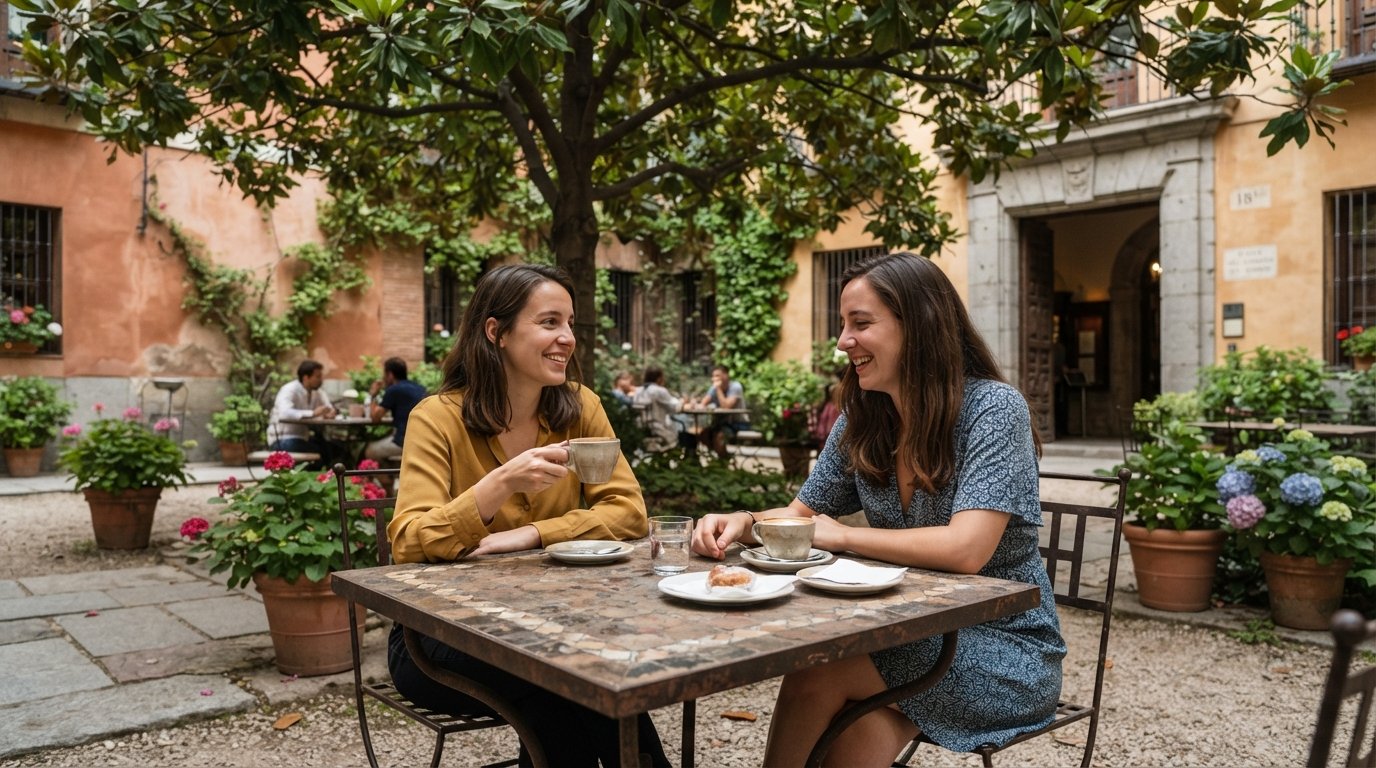
Its Café del Jardín, set in the magnolia garden, is open without a museum ticket and is one of central Madrid's calmer coffee stops. That matters. In a district known for nightlife and polish, a quiet garden café has the power to reset the day.
The other essential thing to do in Chueca is walk. Order a caña on Plaza de Chueca and watch the neighbourhood pass in front of you: shoppers, neighbours, visitors, people meeting before lunch, people who have clearly not yet gone to bed. Then trace the Pride landmarks around Plaza de Pedro Zerolo and read the barrio as a civic space as much as a social one. If you are here in late June or early July, the whole area becomes the attraction, and the squares themselves turn into stages.
Don’t miss in Chueca
Plaza de Chueca, perfect for afternoon people-watching over drinks.
Mercado de San Antón, a multi-story market with food stalls and a rooftop terrace.
Independent shoe shops along Calle Augusto Figueroa.
Shopping
This is the barrio to shop small and specific rather than sweep the chains. Calle Fuencarral, on the western edge shared with Malasaña, is the busy fashion artery, with streetwear, sneakers and youth labels giving it a more immediate, less ceremonial energy than the avenues nearby. Calle Hortaleza runs like a long shop window of tight-cut menswear and boutiques. Calle Augusto Figueroa remains the traditional street for discounted shoe outlets, a useful reminder that Chueca's polish is practical as well as decorative.
Threaded through the grid are independent perfumeries, concept stores, design shops and LGBTQ+ bookshops, the sort of places that reward browsing more than rushed consumption. The Mercado de San Antón doubles as a place to browse as much as to eat, and its ground floor market is a fine place to read the neighbourhood's everyday appetite: fresh produce, cheese, jamón, things to take home or eat on the spot. For a bite between shops, the market and the terraces of Plaza de Chueca are the obvious refuel. Locals like to say that the further you drift from the plaza, the gentler the bill.
Where to stay in Chueca
Chueca works well as a base because it sits so neatly inside central Madrid. You can walk to Gran Vía, Sol, the Prado and Malasaña, and the barrio has its own metro station right on Plaza de Chueca. That convenience comes with a trade-off, and it is worth naming plainly: weekend nights on Calle Pelayo, Calle Libertad and around Plaza de Chueca are loud until dawn. If you are a light sleeper, ask for a room facing an interior patio or choose a quieter block toward the Salesas and Calle San Mateo in the north, where the streets stay calmer while keeping you close to the action.
The feel here is mid-range to upper-mid, with a good spread of design-led boutique hotels and gay-friendly guesthouses. Budget beds exist, but they are thinner on the ground than in Malasaña or Lavapiés. For late June and early July, book well ahead: Pride fills the barrio and rates rise sharply.
Hotels in Chueca
Our best-rated stays in this neighbourhood. Prices are approximate “from” rates — confirmed at the provider when you continue. We may earn a commission if you book through our partners — at no extra cost to you.
In this area
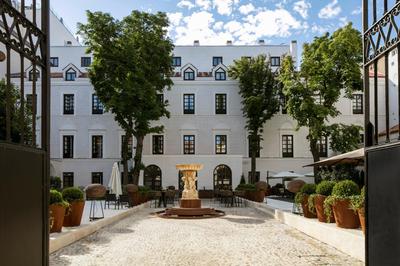
Chueca
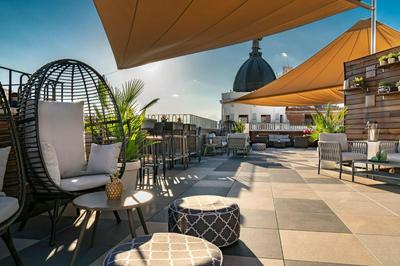
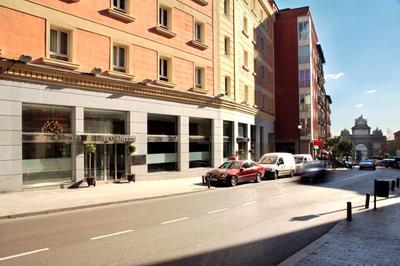
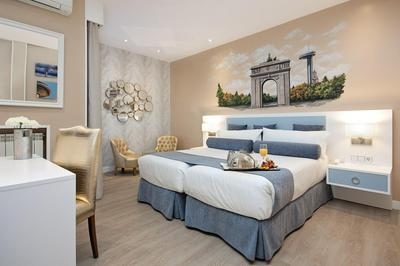
Palacio de los Duques, a Gran Meliá Hotel - The Leading Hotels of the World
9.2· 1,926 reviews
approx. from£738 / nightSee prices
In this area
In this area
In this area
In this area
In this area
In this area
In this area
In this area
In this area
In this area
Getting around
Getting in and out is straightforward. Chueca station on Line 5 sits right on Plaza de Chueca, with the last trains around 1:30–2am. If you prefer to walk, the barrio is small enough to cross in about ten minutes, and Gran Vía, Tribunal, Alonso Martínez and Banco de España are all within a five-to-ten-minute walk. Sol, the Prado, Retiro and Malasaña are also reachable on foot, which is part of why Chueca works so well as a base.
For the airport, the simplest route is metro Line 5 to Alonso Martínez, change for Line 10 to Nuevos Ministerios, then Line 8 to Aeropuerto T4 — about 33 minutes and roughly €5 with the airport supplement. A taxi to Barajas takes around 20 to 30 minutes for a fixed central-zone fare.
There is a practical elegance to Chueca that suits the rest of it: compact, well-connected, easy to read once you have walked it once or twice. The neighbourhood does not ask to be decoded from afar. It asks you to notice the tiled bar, the market roof, the square after midnight, the quieter coffee in the garden, the way a few blocks can hold both a 19th-century taberna and a two-star kitchen. That, more than any slogan, is Chueca.
Gallery
Chueca in pictures
Chueca — your questions
Is Chueca a good area to stay in Madrid?
Yes. It is central, walkable and strong on food, cocktails and nightlife, with a welcoming atmosphere and its own metro. The only real drawback is noise on weekend nights around Plaza de Chueca and Calle Pelayo, so light sleepers should choose a quieter block or an interior-facing room.
Is Chueca safe and welcoming for LGBTQ+ visitors?
Very much so. Chueca is one of Madrid's most open and welcoming neighbourhoods for LGBTQ+ travellers, with busy, well-lit streets and a long-established queer scene. As always in a busy city centre, keep an eye on your bag and phone in late-night crowds, especially during Pride.
When is Madrid Pride in Chueca?
MADO centres on Chueca in late June and early July each year. In 2026 it runs roughly from 25 June to 5 July, with free open-air concerts across several squares and a huge parade from Atocha to Colón, usually on the first Saturday of July.
What is Chueca best for?
Chueca is best for LGBTQ+ nightlife, cocktail and wine bars, boutique shopping and late-night dining. It also works well as a base for walking to Gran Vía, Sol, the Prado and Malasaña.